
Basketball rules for beginners: scoring, time and FIBA–NBA differences
الإيطالي ·
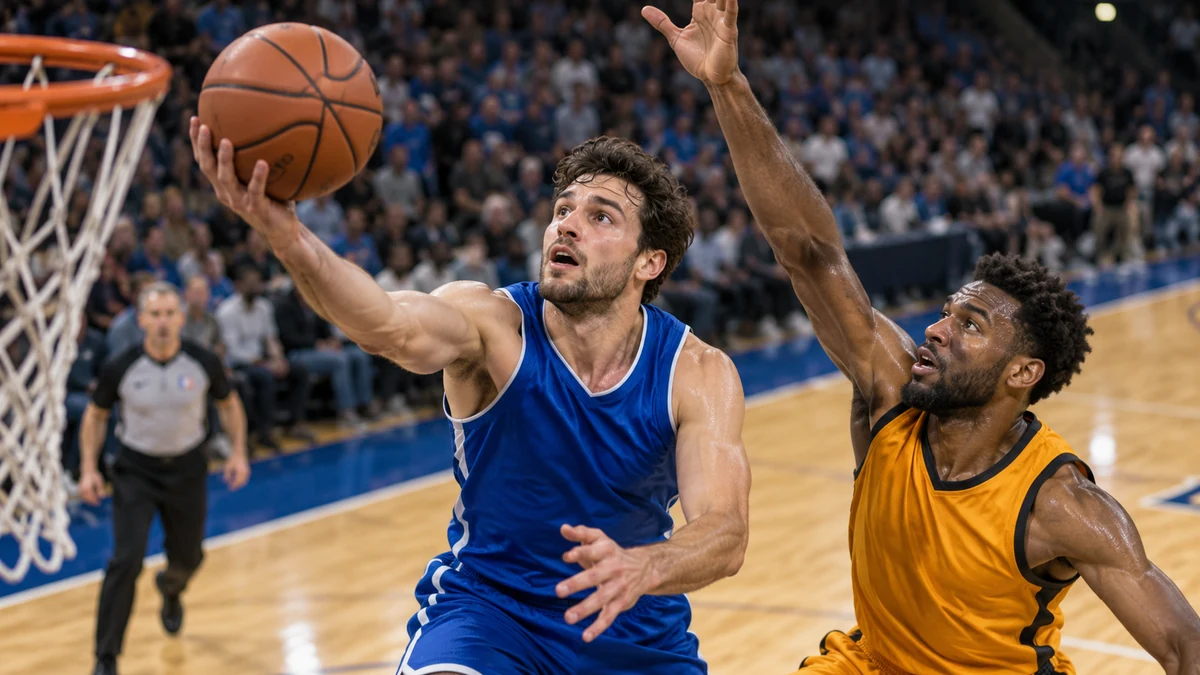
If you are used to football, your first basketball game can be dizzying: the score changes quickly, there are two clocks and plenty of whistles. Basketball rules are easier for beginners when every number connects to something happening in front of you. Here we follow a possession from start to finish in five-a-side basketball, explaining the main differences between FIBA, the international federation, and the NBA, the American league.
Basketball rules for beginners: five against five
Each team has five players on the court, aiming to score in the opposition's basket and protect its own. FIBA 2026, Article 1.
A missed shot does not necessarily end the opportunity. The attacking team may collect the rebound and try again, or the opponents may take it and begin their own possession. This is called rebounding, a word you will hear often in commentary. Watch who collects the ball before deciding that a team has wasted its entire attack.
One point, two or three?
A successful shot from inside the three-point line, or while touching it, is worth two points. From outside it, three; a successful free throw earns one. If a player shoots in the air, the position of their last contact with the floor matters: they can jump from outside the line and land inside after releasing the ball, and it still counts as a three-pointer. Take a simple calculation: a team trailing by five scores a three-pointer, reducing the deficit to two. That is why counting successful shots alone is not enough to understand the score. NBA scoring rules.
Basketball game length: identify the competition first
Under FIBA rules, a game has four quarters of ten minutes each. FIBA 2026, Article 8.
In the NBA, each quarter lasts twelve minutes. If the scores remain tied after the fourth quarter in a game requiring a winner, overtime lasts five minutes under both systems and is repeated until the tie is broken. Those numbers describe playing time; stoppages and intervals make the viewing experience longer. When you see one minute remaining, do not assume the broadcast will end exactly sixty seconds later. NBA timing; FIBA timing.
What does the 24-second clock tell you?
The larger clock tracks the quarter; the smaller one shows the time available to shoot. A new possession normally begins with 24 seconds in FIBA and the NBA. The ball must leave the shooter's hand before time expires and touch the rim or enter the basket; touching only the backboard is not enough. If the shot touches the rim and the attacking team collects the rebound, the clock is set to 14 seconds. Other reset situations exist, but these will help explain why an attack suddenly speeds up. Passing between teammates does not start a fresh period. FIBA, Article 29; NBA shot clock.
Travelling and dribbling: when does the whistle mean a violation?
Travelling is a violation when foot movement with the ball exceeds what is permitted. Not every movement while holding the ball is forbidden: a player may pivot under certain conditions, and legal steps are allowed when gathering the ball on the move. Voluntarily ending a dribble and starting it again is also usually a violation, with exceptions such as losing control after an opponent touches the ball. Watch the whole movement instead of judging from a still image. Travelling or an illegal dribble gives possession to the opponents. NBA travelling and dribbling rules.
Not every contact is a personal foul
Pushing, holding or obstructing an opponent through illegal contact may be a personal foul, but not every touch deserves a whistle. The penalty depends on the situation, including whether the player was shooting. NBA personal fouls.
Under FIBA rules, a player leaves the game after committing five fouls. In the NBA, the usual limit is six personal fouls, with an exception when too few eligible players remain. A player's foul count may explain why a coach takes off a star who is playing well. FIBA 2026, Article 41; NBA foul limit.
Follow one possession and the picture becomes clearer
On your first viewing, ask yourself: who has the ball? How many seconds remain to shoot? Is the attempt from inside or outside the line? Then watch who takes the rebound. You do not have to memorise the entire rulebook at your first sitting. Once you connect the clock with the shot and the whistle, you will begin to read the game and understand why the crowd got excited about a moment that passed you by.